
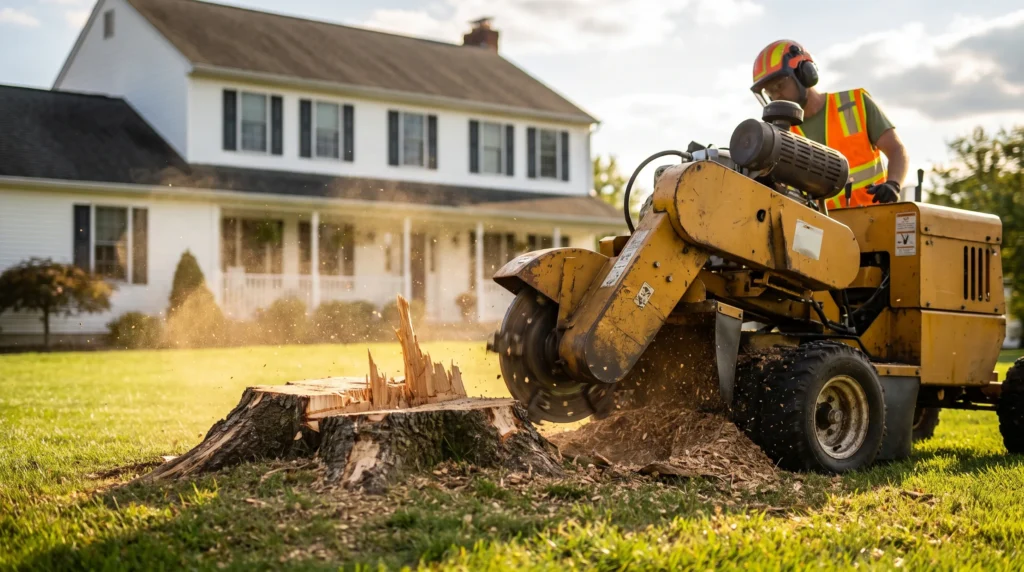
Once a tree has been taken down, the stump is what is left of the decision. Some homeowners are happy to leave it, plant a pot of flowers on top and move on. Most want it gone, because a stump is a mower obstacle, a trip hazard, a home for carpenter ants and the one thing in the yard that keeps reminding you of the tree. There are two ways to get rid of it: grinding, which chews the stump into chips below the surface, and full removal, which pulls the stump and its root ball out of the ground. They are not interchangeable. This guide explains how each works, what each costs and how we choose between them on a typical Monroe County property.
What stump grinding actually does
A stump grinder is a machine with a spinning carbide toothed wheel that we sweep back and forth across the stump, shaving it into chips a layer at a time. We keep going until the stump is gone to a set depth below grade, typically six to eight inches for a lawn and up to twelve inches or more where you plan to plant, build or pour. The chips, a mix of wood and soil, either go back into the hole as backfill or get hauled away and replaced with topsoil.
Grinding removes the visible stump and the top of the root system. It does not remove the roots that run out under the lawn. Those stay in the ground and decay on their own over several years, which in almost every case is fine; they are below mowing depth, they are not going to sprout once the stump is gone, and they feed the soil as they break down. The exceptions are species like poplar, black locust and some maples that can sucker from roots. For those we grind a little wider and deeper and chase the main surface roots.
Our grinders range from a compact walk behind unit that fits through a 36 inch gate for tight side yards in the city, to a larger tracked machine for big stumps and open lots. Access is rarely a problem. Most stump grinding jobs take under an hour, and grinding on the same visit as a removal is the most economical way to finish the job.
What full stump removal involves
Full removal means digging out the stump and the root ball as a unit. On a small tree that can be done by hand with a mattock and a saw. On anything with a trunk over a foot across, it means an excavator or a backhoe, a lot of digging, cutting the lateral roots, and levering a mass of wood and soil that can weigh over a ton out of a hole that is now several feet across and several feet deep. The hole then has to be backfilled with imported soil and compacted so it does not settle.
Removal is more disruptive, more expensive and harder on the surrounding lawn than grinding, but it leaves the ground completely clear of roots. That matters in specific situations, which we will get to. For a stump in the middle of a lawn, it is almost always more work than the situation calls for.
Cost: why grinding is usually the answer
Grinding is priced by the size of the stump, measured across the widest point at ground level, plus any surface roots you want chased and whether the chips are hauled. A typical residential stump in Greece, Irondequoit or Henrietta is a few hundred dollars, less when bundled with the removal. Full removal on the same stump is often three to five times that, because of the machine time, the disposal of a root ball full of soil and the backfill.
The lawn is the other cost. A grinder on rubber tracks or turf tires can work from a driveway or with ground protection mats and leave the lawn intact. An excavator digging a stump out of a back yard leaves a scar that needs regrading and reseeding, and the hole takes a season or two to stop settling.
When full removal is the right call
There are a few situations where grinding is not enough and we recommend pulling the stump.
- Building on the spot. A foundation, a slab, a retaining wall or a swimming pool cannot sit on decaying roots, which settle unevenly as they rot. If the stump is inside the footprint of a structure, it and the major roots have to come out.
- Land clearing for construction. When we are clearing a lot for a new build in Webster or Penfield, the whole site is being graded anyway. Pulling stumps with the excavator that is already on site is faster than grinding each one, and the builder needs clean subgrade. This is standard practice on our land and lot clearing jobs.
- Diseased root systems. Some root diseases, such as Armillaria root rot, can persist in the roots of a removed tree and infect a replacement planted in the same spot. If a tree died of a root disease and you want to replant close by, removing the infected roots is the safer choice. Cornell Cooperative Extension can help identify what killed a tree if the cause is not obvious.
- Aggressive suckering species. Tree of heaven and black locust can send up shoots from roots dozens of feet from the stump for years. Grinding the stump does not stop them. Removing as much root as possible, followed by treating any shoots, is the only reliable approach.
When grinding is the better choice
- A stump in a lawn. Ground below mowing depth, backfilled and seeded, the spot is invisible by the following summer.
- Replanting a new tree. Grind deeper, remove the chips, backfill with topsoil and plant a few feet to one side of the old root plate so the new tree is in undisturbed soil. Most of the old roots will have decayed by the time the new tree needs that space.
- Tight access. Fenced back yards, side yards between houses in the city, and anywhere an excavator cannot go without taking down a fence. A walk behind grinder gets in and out through a standard gate.
- Multiple stumps. A property with a row of old stumps from a previous owner’s removals can be cleaned up in a morning by grinding. Digging each one out would take days.
- Near utilities and foundations. Grinding is controlled and shallow. Excavating a root ball next to a gas line or a foundation is neither.
Before any stump work: the utility locate
Whichever method you choose, the ground has to be checked first. Gas, electric, water and communications lines run through residential yards at shallow depths, and roots have a habit of growing right alongside them. We call in a locate through UDig NY before we grind or dig, and the marked lines dictate how deep and how wide we work. Private lines that the utilities do not mark, such as irrigation, low voltage lighting, invisible dog fences and the line to a detached garage, should be flagged by the owner before the crew arrives. A quick walk around with us at the estimate is enough.
What happens to the chips and the hole
Grinding produces a surprising volume of chips: a two foot stump can fill several wheelbarrows. You have three options. We can rake the chips back into the hole and mound them slightly, which is the cheapest choice; they settle as they decay over a year and the spot can be topped with soil and seeded then. We can haul the chips and backfill with topsoil on the same visit, which gives you a finished spot you can seed immediately. Or you can keep the chips for mulch on beds, where they are perfectly good, and we backfill with topsoil. Fresh chips mixed into the soil tie up nitrogen for a while, which is why we do not recommend seeding directly into a chip filled hole.
After a full removal, the hole is bigger and the backfill is imported soil compacted in layers. Even so, expect some settling for a season and plan to top it up before final seeding.
Our recommendation, most of the time
For the typical Rochester situation, a tree that came down in a lawn or a bed with no construction planned, grinding is the right answer. It is faster, far cheaper, gentle on the lawn and the result is a spot you cannot find a year later. We recommend deciding on the stump before the removal, not after, so it can be done on the same visit; a second trip for a grinder is the most common avoidable cost we see. If you are still deciding whether the tree itself needs to come down, our guide to the signs a tree needs to be removed is the place to start, and if you are thinking about the trees you are keeping, preparing your trees for a Rochester winter is the next thing to read.
Apex Tree Service grinds and removes stumps across Rochester and Monroe County, including Greece, Irondequoit, Penfield, Pittsford, Henrietta and Webster. Every job starts with a free written estimate, and the utility locate is always on us.
Need a hand with a tree?
Free estimates across Rochester and Monroe County. Call or send the form.